
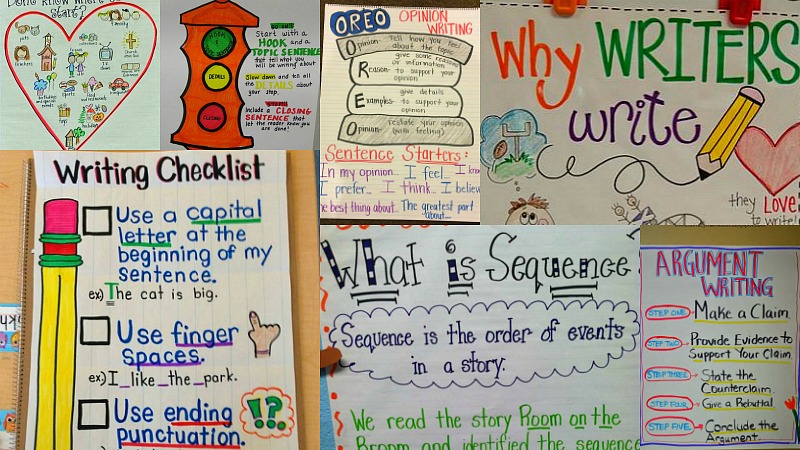
Walk into any classroom and you see a plethora of goodies all over the walls. You see posters covering every wall, number charts, word recognition skills, rules, birthdays, charts, and more. A teacher’s room has encompassed every subject (or the specific subject) for the sole purpose of recollection and wonder. Some teachers use these posters as tools as a point of reference, some teachers use them simply because they are told to. But regardless, teachers do it, and they do it with abundance when they can.
There is nothing wrong with not being able to draw, and I should know.
Welcome to the world of anchor charts; aka, the teacher-poster. Anchor charts are, to the lesser known, simple posters that teachers create. Yes, instead of a licensed artist’s depicting the appropriate amount of materials, key vocabulary, and information, a teacher does it. This is silly to me. We expect to differentiate our instruction for our students based on their ability level and differentiate based on their learning style, yet we expect all teachers to just simply do what we are told to do, or what is expected us to do. There is nothing wrong with not being able to draw, and I should know.
One year I was actually given a verbal warning because I lacked enough “Teacher-Created anchor charts.” Devastated by the criticism, and a bit shell-shocked, I set off to ponder. I thought, “How the hell can I create something as visually appealing as these artistic renditions of the organelle’s of a cell, the layers of the Earth or even the spectacular beauty of the grand scale of the solar system?!” Flustered, I thought I should simply take this idea to the client; the students. I explained to them of how I need to create these anchor charts, and I also demonstrated (with my best work I thought) my anchor chart, and we compared to another pre-made version from an artist. Clearly, the students were more appealed to the fancy version verse my three-toned marker version. Stunned, the epiphany was unfolding before me.
Students all over the room began to regroup into groups of 4-5. They all brought out several different markers and colored pencils, rulers and their computers researching. Students were grabbing and cutting from the large butcher paper enormous sheets of paper as if they were on a mission. Throughout the days the students were re-creating the anchor charts all over the room! My entire room was completely filled with these glorious student lead anchor charts. They had everything from Earth science, Life science and Physical science terms, formula’s, and models everywhere! There were so many that they covered the walls outside of our room as well!
Know this, not all students would be so willing to take up a student-created task with such spontaneity, and we all know this. So why did it happen? Why in the world would students do this?!
Talking to the students, they wanted to help, they wanted to create, they wanted to do something different. Having built an incredible relationship with my students, they knew that I was flustered about this without ever telling them directly about the reasoning why I needed these anchor charts. They wanted to be part of something, they wanted to help. They most of all wanted to show off their skills in a unique way; whether with directing, collaborating, researching, designing. Those students demonstrated that they have all of the abilities that they need to be successful in life.
As cliché as the saying is, “If you provide, they will show up.” The opportunity arose, and the students showed up. I always will trust the feedback of ideas from my number 1 client, the student. They will be honest, they will be straightforward and they will be shameless. This may sound harsh, but understand they have not learned the art of refined skills. They are not beating around the bush about anything, and this is a positive. Do not be afraid to ask students for feedback. Do not be afraid to hear criticism from your students. You are the adult, and you have much thicker skin from words to help a student. See through their words, and find their meaning.
Meanwhile, that room was observed again. I was told that I was being a smart-ass for covering my entire room in anchor charts. Sometimes, you can never win a battle, but I did gain a valuable strategy; ask the students for feedback. Student created anchor charts was a pretty good strategy also!
Recent Comments